The switch from my haven of Futures and Fx, to the world on USA equities and ETF's to run a Hedge Fund, presented a new set of challenges. My world had moved from 80 instruments to focus on to more than 10 times that. It was obvious, that whilst much of what I had built transferred across easy enough, I would have to build new code and studies that met these new challenges. Namely, less is more, so code that was so rare on Futures as be largely redundant in day-to-day trading, was far more useful on Equities. Tracking momentum was also a new obstacle as trends can last far longer on Stocks than Futures.
My immediate thought was to use multiple timeframe tracking of momentum but instead of on a continuous basis as the bast majority do, was to devise a way to splice time so that it continuously reset as each timeframe ended and therefore create a stepping process that told me if the trend was continuing or beginning the process of changing. This would have particular use in identifying when Sector Rotation was imminent, whereby the best performing sectors would move out of fashion and the unloved become loved. Therefore, my focus was constantly concentrated on the top and bottom five, with no interest in anything in between, unless something compelling appeared in my scans.
This also allowed for a balance of long and shorts, safe in the knowledge that it is far easier and cheaper to borrow a stock that has been performing well.
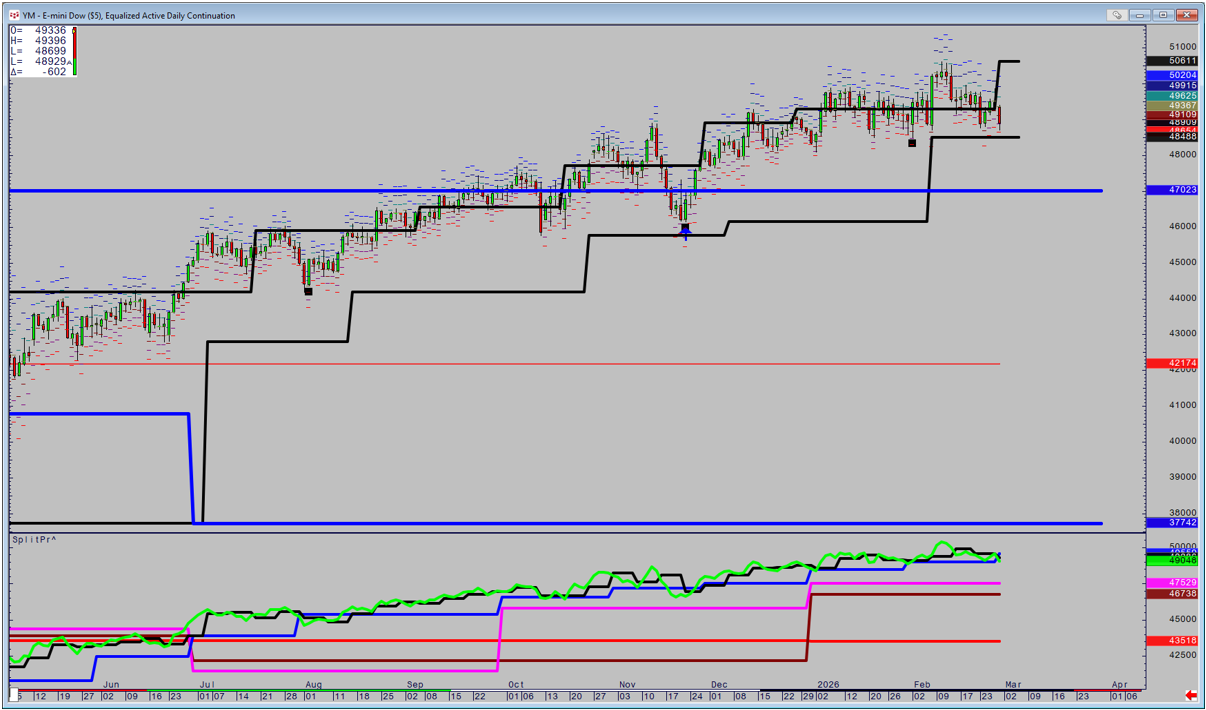
The study is called Splits and is takes the previous equilibrium point of the previous week (black), month (blue), quarter (pink), 6 months (brown) and year (red). The green line is simply the daily price. The study holds that value until the calendar dictates that they reset and therefore creates the stepping process.
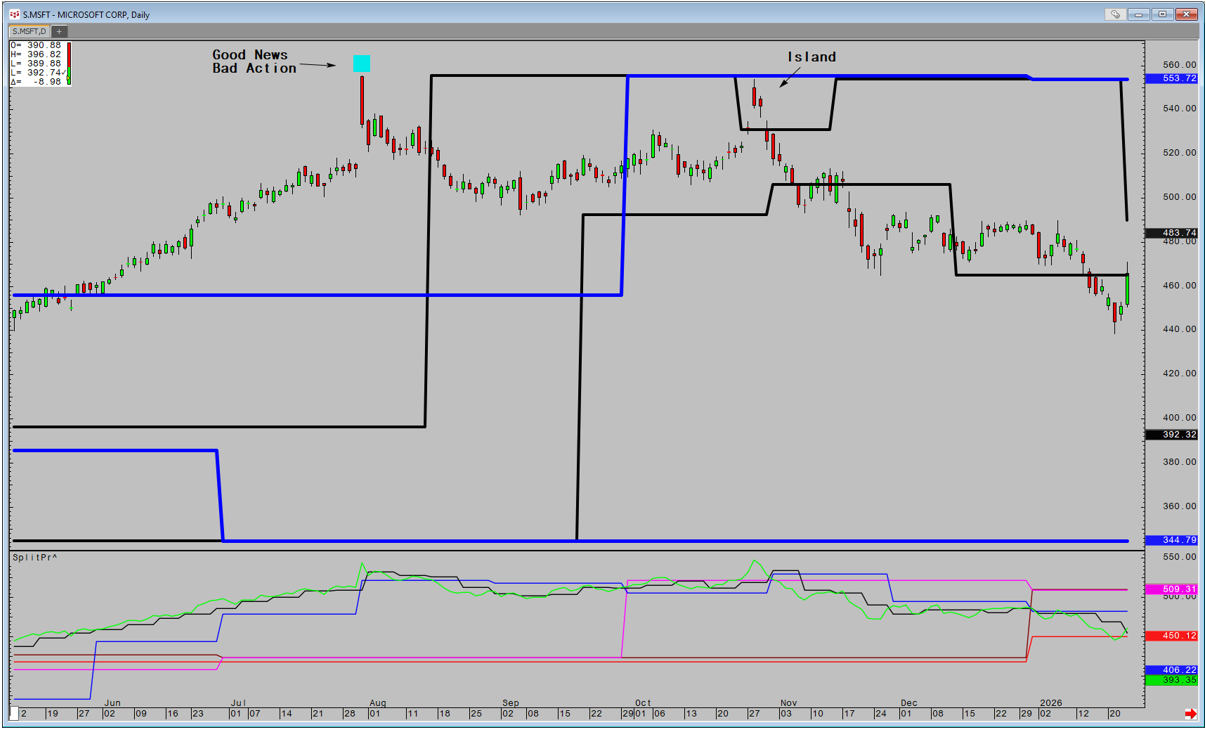
The obstacle in understanding what constituted a breakout or reversal returned to the Range Deviation Pivots, which continually evolve with the history of Range and have a skew for the trend. If the trend is up, the Pivots above grow wider apart, whilst the ones below contract. This gives room for the trend to potentially accelerate without reaching an extreme, whilst the longer the trend the less countertrend movement will be required to signal a reversal. This is activated by the Range extending beyond 6 Deviations from the Opening price. Often these signals are generated by news events such as results. The Slammdunk signal on Microsoft was a classic example of Good News Bad Action although the signal was not at resistance. Only the Peak Weekly or Monthly lines are deemed to be valid if there is no current position with the Daily levels added once there is. Later, an island Reversal appears and now there is powerful weekly and monthly resistance lying just above.
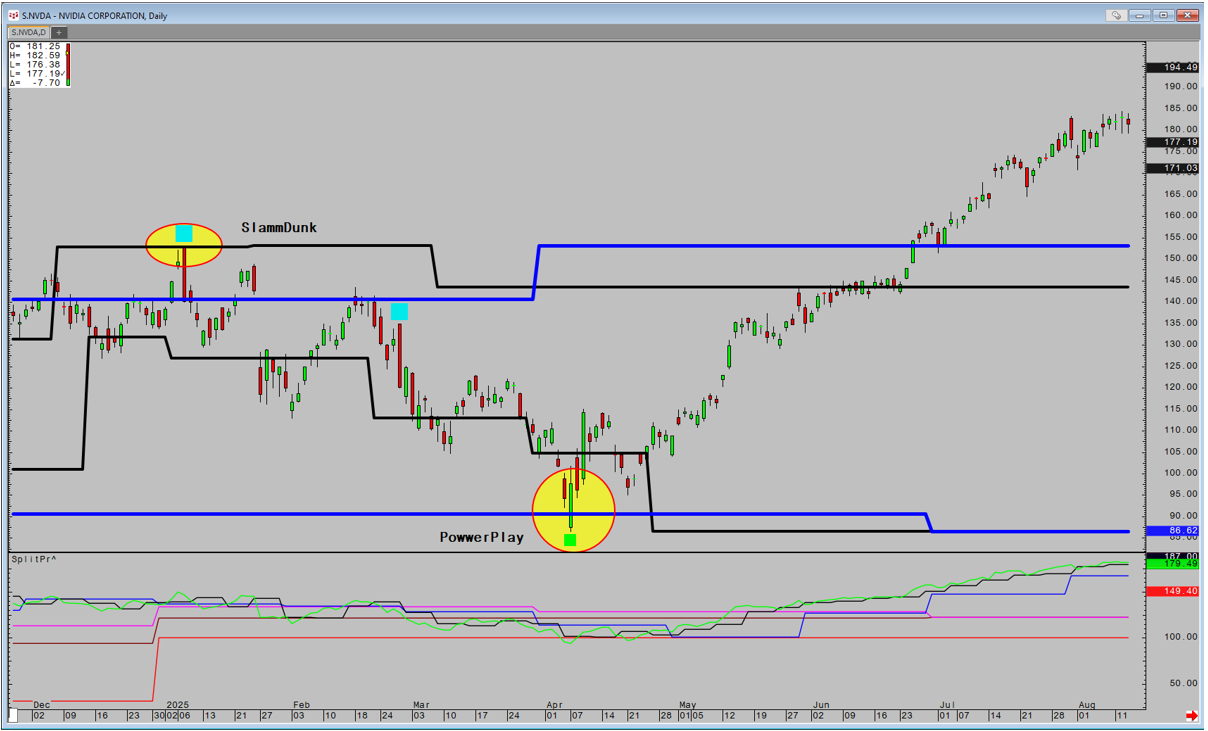
My preference is for signals that are not news related as there is nothing to interpret. Nvidia last year had a negative Slammdunk at weekly resistance, but the major buy signal was during the Tariff wars. A Powwerplay signal appears at final monthly based support and marks the low.
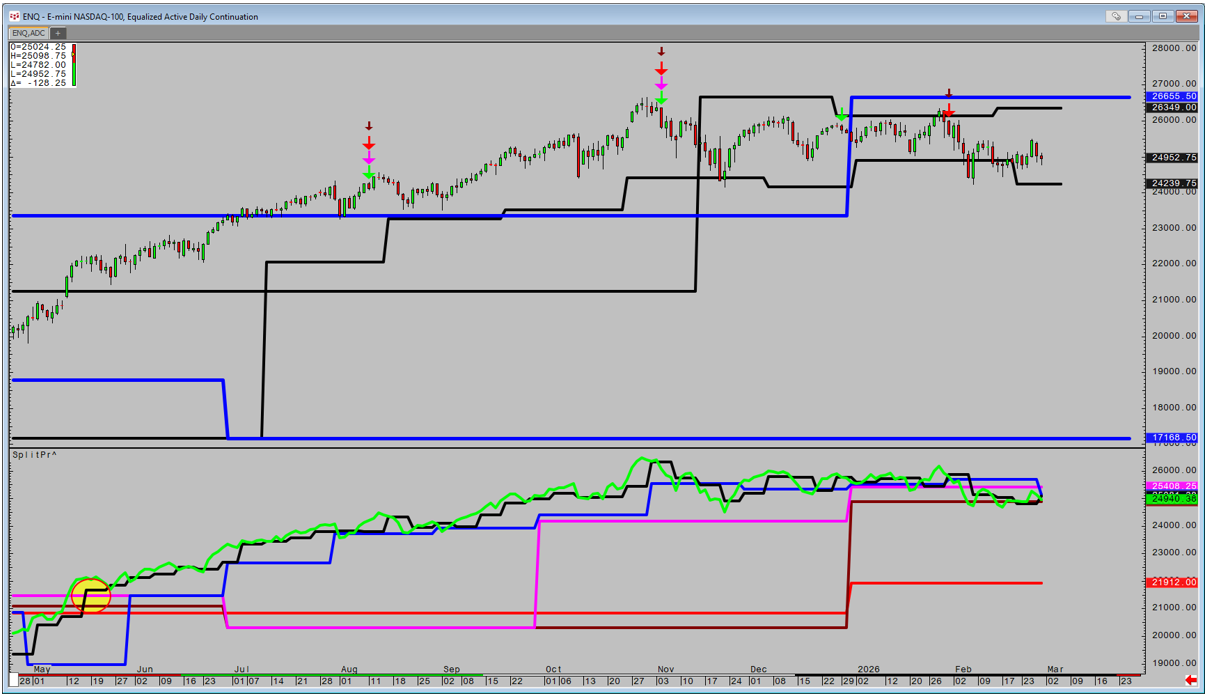
Splits not only identifies sector rotation but also the relative performance between Index's. Beginning with the Nasdaq Future, it shows that the Monthly is stepping down with price below the Quarterly value, having attacked the semi-annual level. Historically there is only one major support below at 24,239.75. The breakout higher in May saw a continual stepping up process until December and at the beginning of the year, momentum had caught price up.
In contrast, the Dow did not break up until July, but since then has seen a continual stepping up process and lies above the quarterly and semi-annual. It has a major monthly based support at 47023.
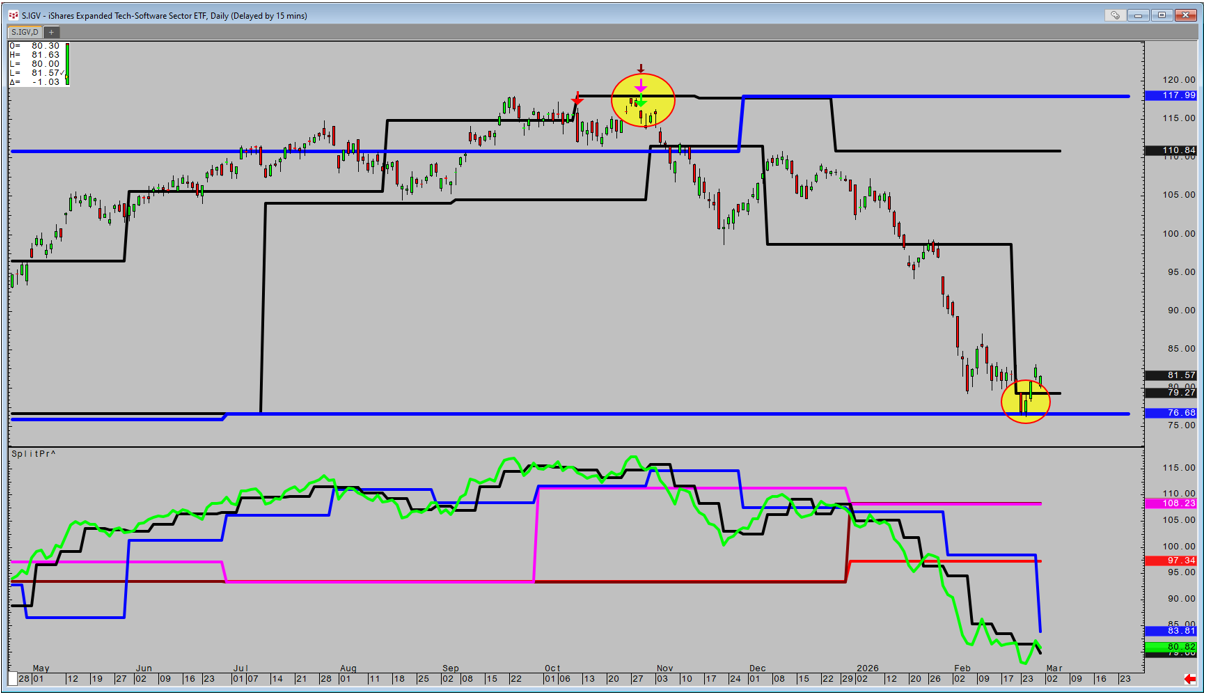
The Tech Software ETF (IGV) highlights how a sector goes to Unloved from Loved. Having broke up last year, both Splits and the change in Historical supports and resistances saw them catch price up. The RSI based negative divergences were a warning signal that all was not well, especially as the second pattern had occurred directly at final weekly resistance. Just two weeks later price closed below the weekly and monthly support and price went below the quarterly splits level, leaving no support. In spite of a recovery in December the Monthly split moved down in January and set off another slide. Ultimately, the major downside target was the monthly and final support at 76.68 which price reached this week.
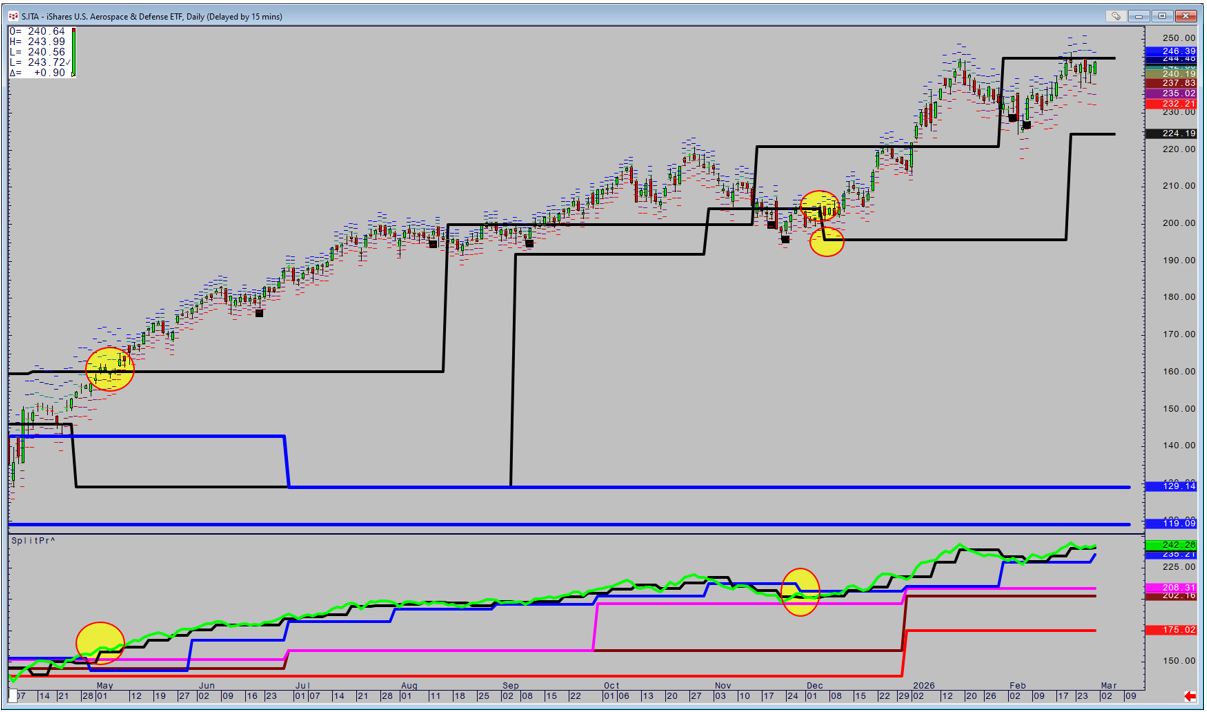
It is no surprise that Aerospace and Defence (ITA) is still loved. Having broke up last May, the only blip came in December when price broke below historical support and the Monthly stepped down on Splits. However, a few days after the break, weekly resistance switched so support as circled and price was still above the quarterly Splits level. Currently Splits continues to step up and there is no sign of any topping process.