
- Silver has been in a bearish trend since the January 2026 all-time high
- A bullish long-term trend remains intact
- The long-term technical resistance is now support
- Open interest has declined on long liquidation
- Expect lots of volatility in silver and the potential for a false technical breakdown
For 45 years, silver remained below its technical resistance at the 1980 high of $50.36 per ounce. In October 2025, that resistance gave way to an explosive, parabolic silver rally that more than doubled the price in under four months.
COMEX silver futures reached a record high of $121.785 per ounce on January 29, 2026, where it ran out of upward momentum, and the explosive move led to an implosive correction.
In late 2026, silver is closing in on the 45-year technical resistance level that is now critical technical support.
Silver has been in a bearish trend since the January 2026 all-time high
The monthly chart highlights silver's explosive rally that led to a bearish trend from late January through late October 2026.
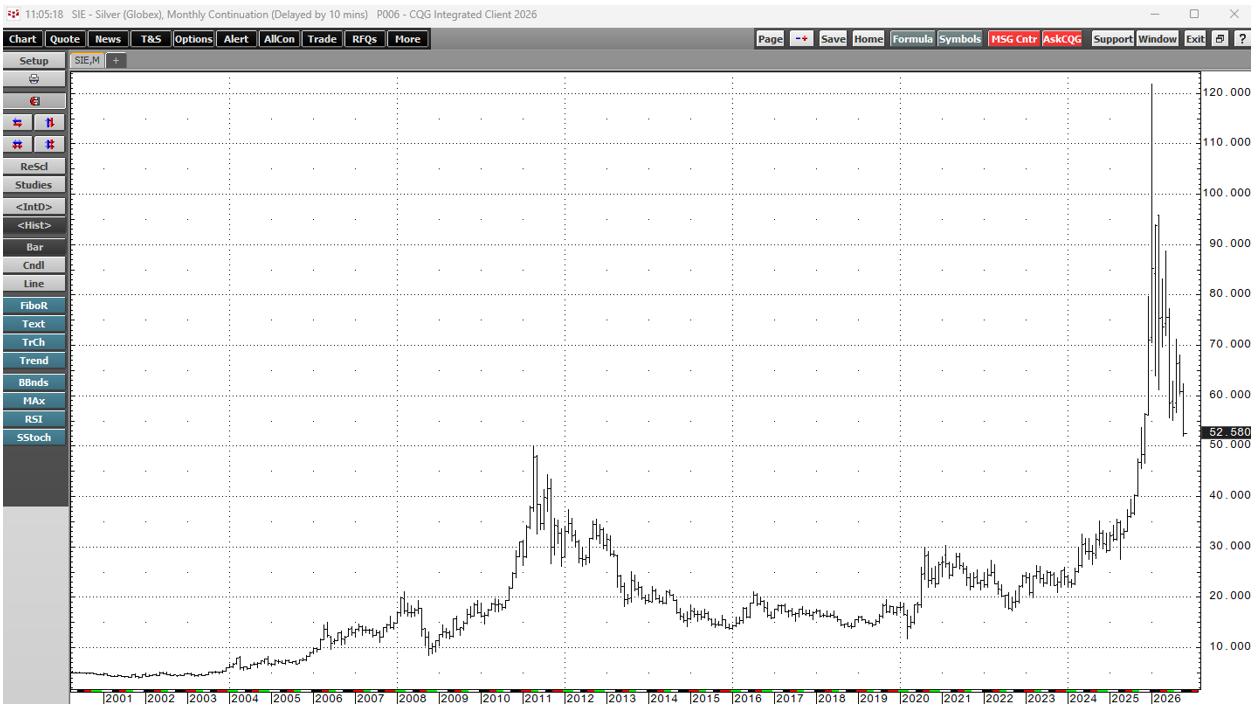
The monthly chart shows that after closing 2025 at $70.98, following a record high of $79.70 per ounce in December 2025, silver rallied 52.8% in under a month, reaching $121.785 on January 29, when the explosive bullish price action suddenly ended. Silver has made lower lows and lower highs throughout 2026, hitting a low of $52.025 per ounce on October 29. Silver has corrected 57.3% from the late-January high to the late-October low.
A bullish trend looks shaky
As silver futures more than doubled from October 2025 through January 2026 and more than halved from January 2026 through October 2026, the bullish trend has faltered with the price just over $52 per ounce in late October 2026.
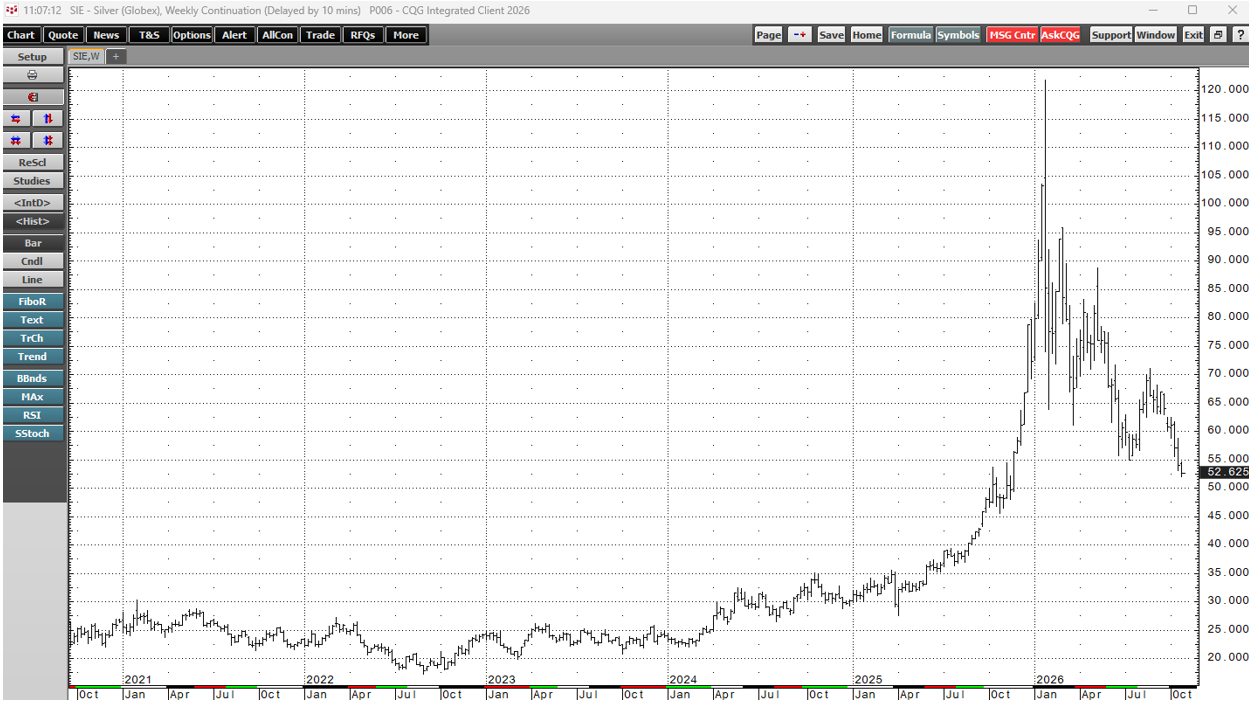
The weekly chart shows COMEX silver futures fell to a low of $27.545 per ounce in April 2025, when the U.S. administration announced its "Liberation Day" tariff policies, sending markets across all asset classes lower. Silver and other metal prices fell amid tariff uncertainty, as silver is a global financial metal with many industrial applications. Silver futures moved over 4.4 times higher from the April 2025 low to the January 2026 high, an incredible rally in only nine months.
The long-term technical resistance is now support
While the correction from the late January high has been ugly, silver has yet to test its critical technical support that has kept the long-term bullish trend intact in 2026.
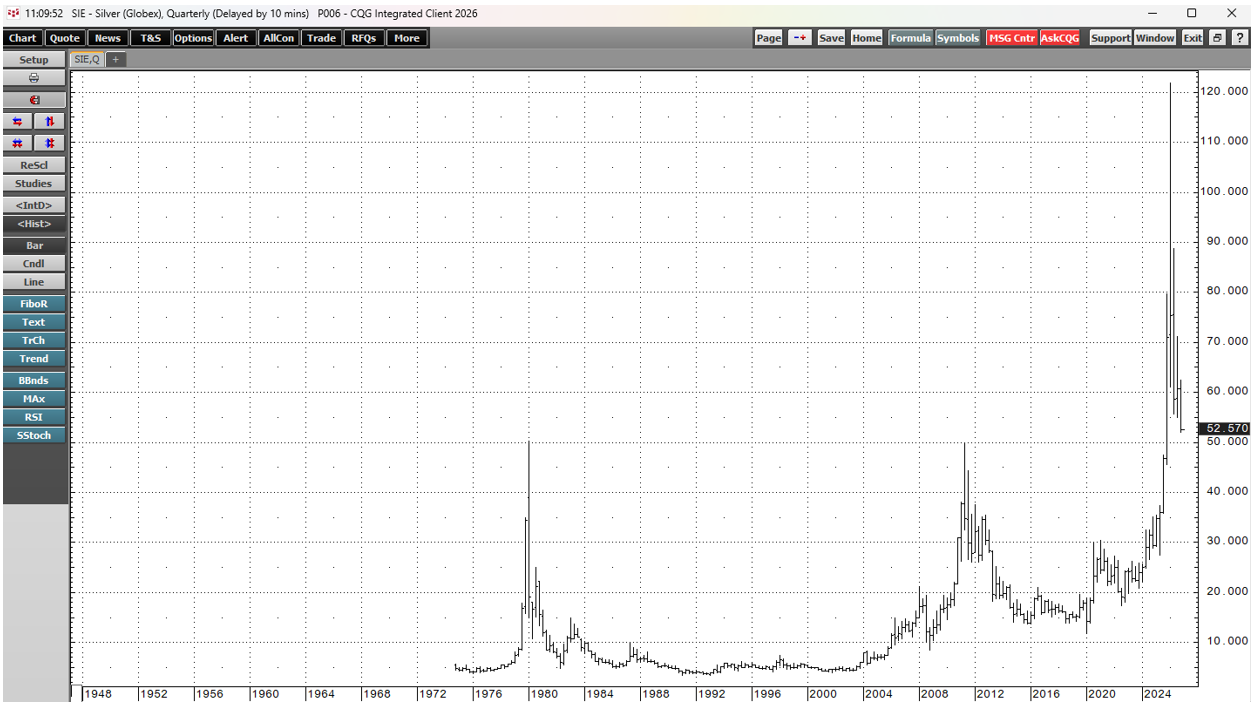
The chart shows that the 1980 high of $50.36, which was critical technical resistance for four and a half decades, became technical support in October 2025. Silver stopped short of the 1980 high in 2011 when the price reached $49.82 per ounce. Volatile silver futures fell by more than 76.4% from the 2011 high in 2020, when the price fell to a low of $11.74 as the global pandemic triggered a severe risk-off period across asset classes.
As silver heads into the final two months of 2026, the odds of a test of technical support at the 1980 high of $50.36 per ounce have risen. While silver has moved closer to a test of the support level, the price has remained above it, for now, keeping the long-term bullish trend, albeit shaky, intact.
Open interest has declined on long liquidation
Technical indicators provide some clues about silver's potential price path over the coming weeks and months.
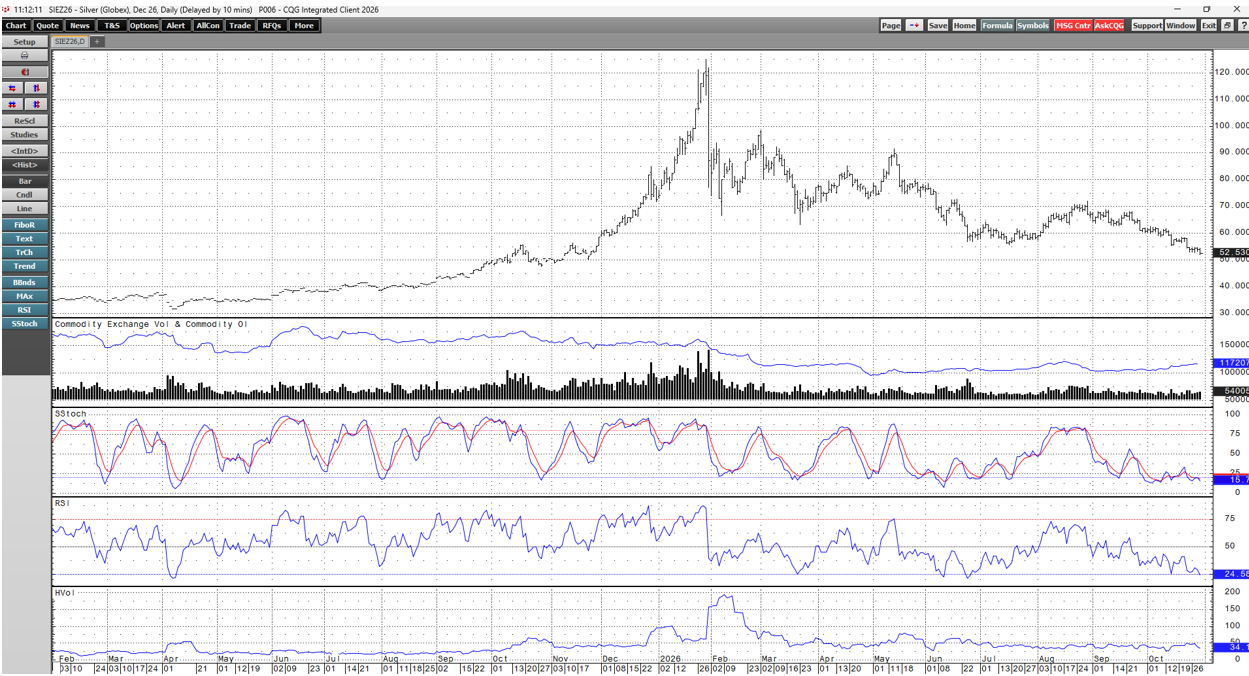
The daily chart shows that the open interest in COMEX silver futures, the total number of open long and short positions, has declined by 27.6% from the 2026 high of 161,943 contracts on January 26, to 117,207 contracts on October 23. Over the same period, daily trading volume has declined. After reaching daily highs of more than 360,000 contracts on January 26 and 30, it has not been above 160,000 contracts and has been as low as below 27,000 contracts since early February. Falling volume and lower open interest as the price declines do not validate a bearish trend; however, they do reflect significant long liquidation since the late January 2026 high.
Meanwhile, the slow stochastic and relative strength readings have declined to oversold territory on the daily chart, and daily historical volatility, which reached a high of over 190% when silver's price plunged in late January and early February, has declined to below 35% in late October.
Many of the technical indicators support a recovery in silver prices, but silver has a history of defying technical factors.
Expect lots of volatility in silver and the potential for a false technical breakdown
Silver is the most volatile precious metal. In the late 1970s and early 1980s, the Hunt brothers attempted to corner the silver market by pyramiding futures contracts, or using rising equity on long silver futures positions to purchase more silver futures. When prices turned lower, and the COMEX Board of Governors instituted a liquidation-only rule, silver prices plunged, and the brothers were left holding a much less valuable bag of silver as the price dropped by over 90% from $50.36 in January 1980 to a low of $4.78 in June 1982.
The price action that took silver to a record high in early 2026 was far different from that in 1980; it has been much more volatile. Silver dropped 78.6% from the January 1980 high to the May 1980 low of $10.80, before falling another 55.7% from the May 1980 low to the June 1982 low. So far, silver futures have declined 57.3% in 2026. As silver approaches technical support at $50.36, there are no guarantees it will hold the 1980 high or the 2011 lower high of $49.82 per ounce. Higher interest rates and the lowest level for the 30-year U.S. government Treasury bonds since 2002 are typically bearish for silver and other metal prices. A rising dollar index is another bearish factor. However, stubborn inflation, rising debt, and geopolitical turmoil have historically been bullish for silver and other metals.
As we learned in late 2025 and early 2026, and throughout silver's volatile price history, bullish forces can send prices to levels that defy reasonable, rational, and logical technical and fundamental analysis. The same holds on the downside, which could mean that significantly lower lows are possible for silver. Therefore, trading silver with a clear and defined risk-reward plan using stops and accepting small losses in pursuit of greater gains is likely to be optimal. Sentiment in silver is likely to drive the next significant price move as it remains the precious metal that attracts the most speculative interest.