
- The Middle East explodes, sending crude oil prices higher
- Brent outperforms WTI for obvious reasons
- The levels to watch in crude oil over the coming weeks
- The optimistic case
- The pessimistic case
Crude oil remains the energy commodity that powers the world. After falling to lows below $60 per barrel in late 2025, prices have soared amid supply fears sparked by the war in Iran. The blockage of the Strait of Hormuz, a critical logistical chokepoint for petroleum and other crucial commodities, including, but not limited to, aluminum and fertilizers, has not only driven prices higher but has sent shockwaves through markets across all asset classes.
As markets head into April 2026, the war's outcome will have a significant impact, and we should expect elevated volatility.
The Middle East explodes, sending crude oil prices higher
On February 28, 2026, the United States and Israel attacked Iran. The Iranians retaliated by striking countries throughout the Middle East, expanding the conflict to a regional war. Meanwhile, traffic through the Strait of Hormuz, a critical logistical passage, ground to a halt, raising concerns about crude oil, crude oil products, liquefied natural gas, fertilizer, and other commodities. Crude oil prices, which fell below $60 per barrel in late 2025 and early 2026, rose to over $100 per barrel.
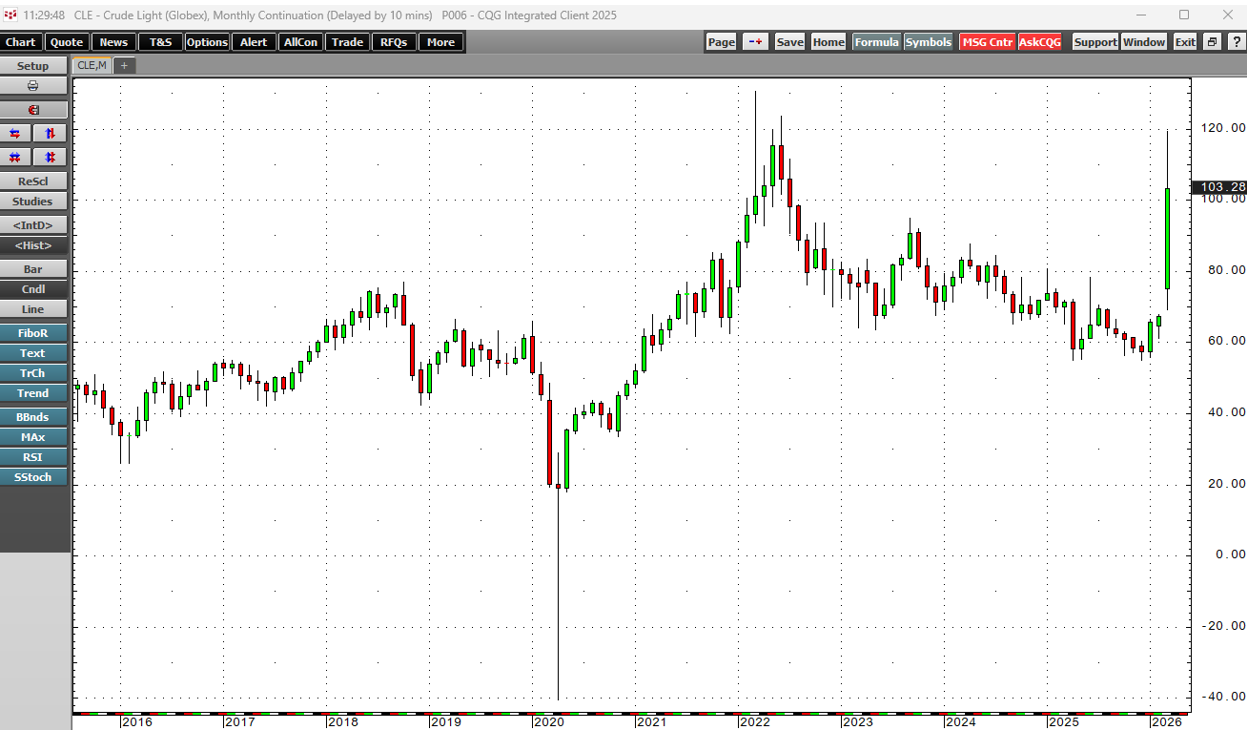
The monthly chart shows that NYMEX WTI crude oil futures rose to the most recent high of $119.48 per barrel on March 9, the highest price since June 2022. Brent crude oil reached $119.40 per barrel on March 9.
Brent is the benchmark for Middle Eastern crude oil, so it was counterintuitive that WTI traded slightly higher on March 9. However, supply concerns caused by attacks in the region and the stoppage of traffic through the Strait of Hormuz caused a rush to secure WTI, sending its price slightly higher when the oil market reached its most recent high. However, Brent has returned to a substantial premium to WTI over the past weeks.
Brent outperforms WTI for obvious reasons
Aside from the price action on March 9, 2026, Brent futures have risen to the highest premium over WTI futures in thirteen years.
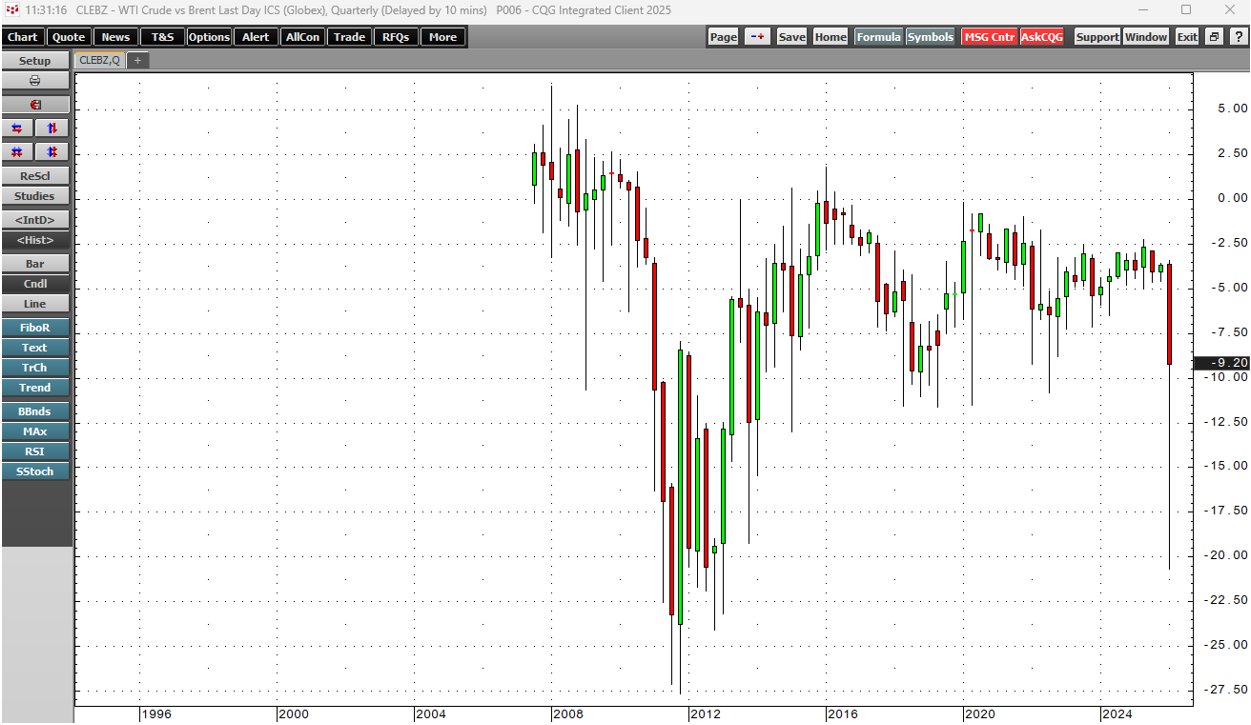
The quarterly chart of WTI minus Brent crude oil prices shows that the Brent futures rose to a $20.69 per barrel premium on March 19, the highest level since January 2013.
Brent has a slightly higher sulfur content than WTI, making it suitable for refining into distillate products.
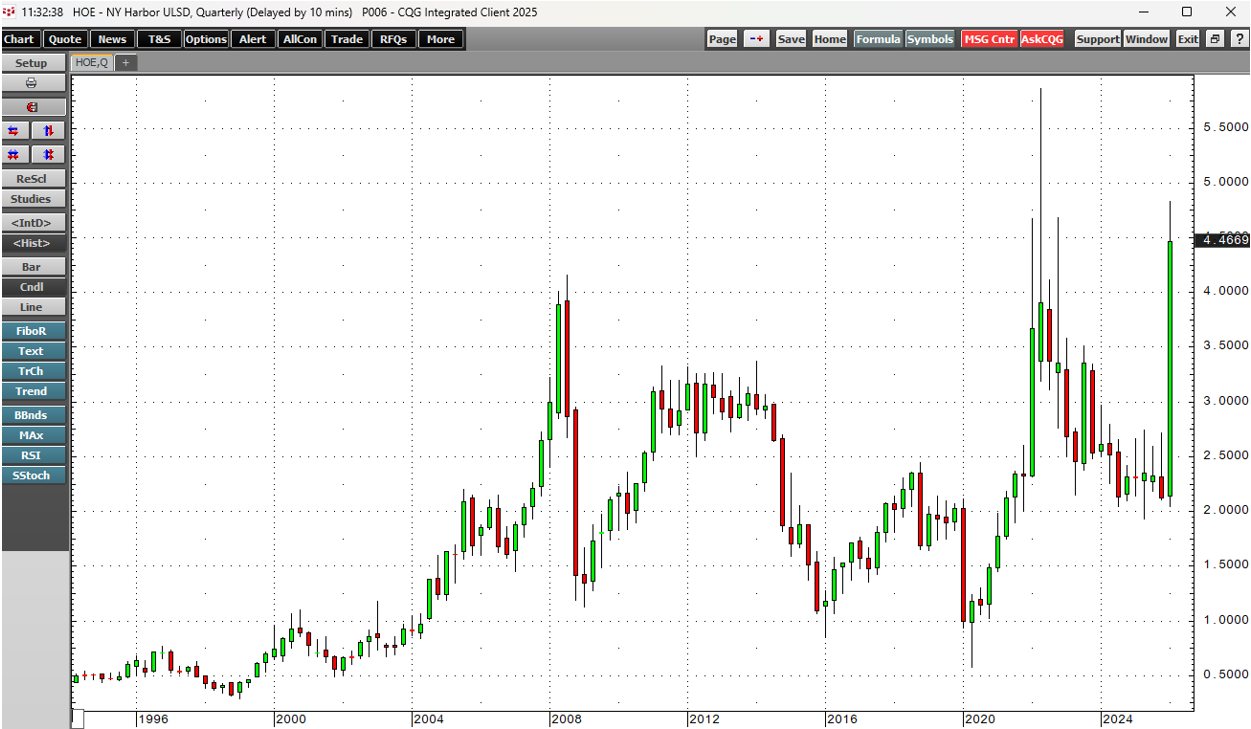
Supply concerns for distillate products pushed heating oil futures prices to a high of $4.8353 per gallon wholesale, the highest price since April 2022. Heating oil is a proxy for other distillates, including jet and diesel fuels.
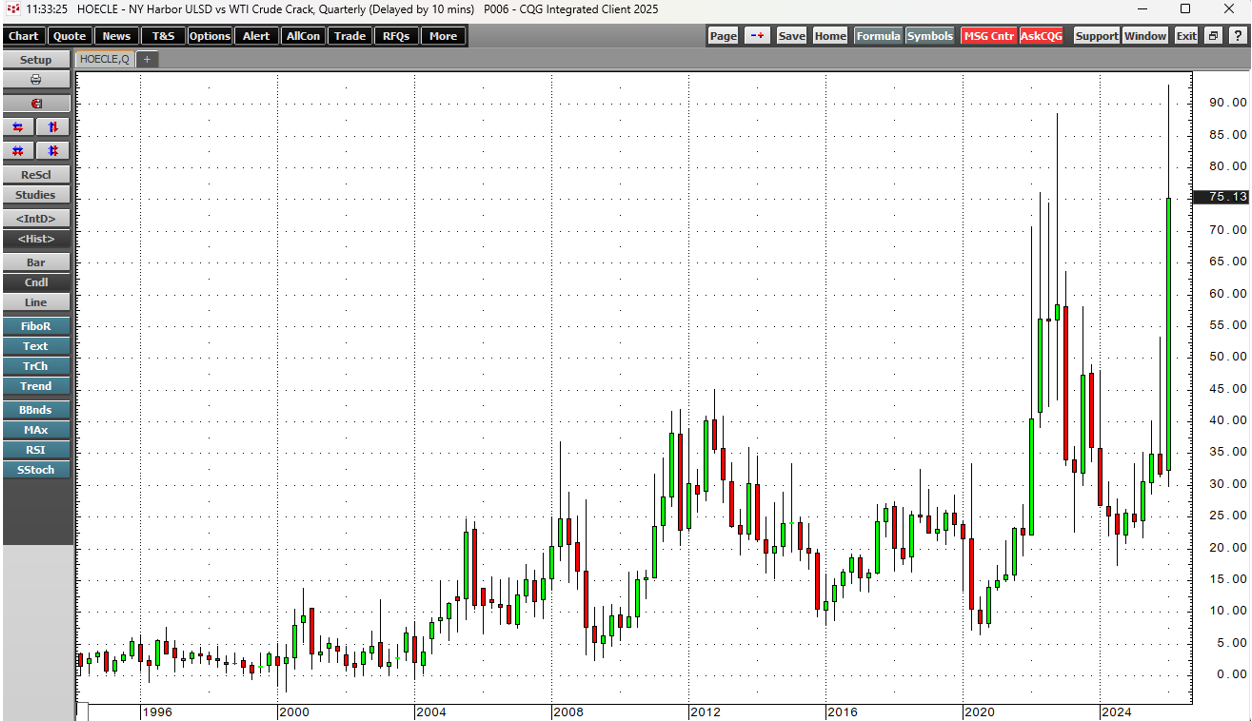
The chart of the distillate refining spread shows that it rose to $92.95 per barrel, the highest level in history.
The levels to watch in NYMEX crude oil over the coming weeks
After trading at nearly $120 per barrel, WTI crude oil prices have corrected in late March.
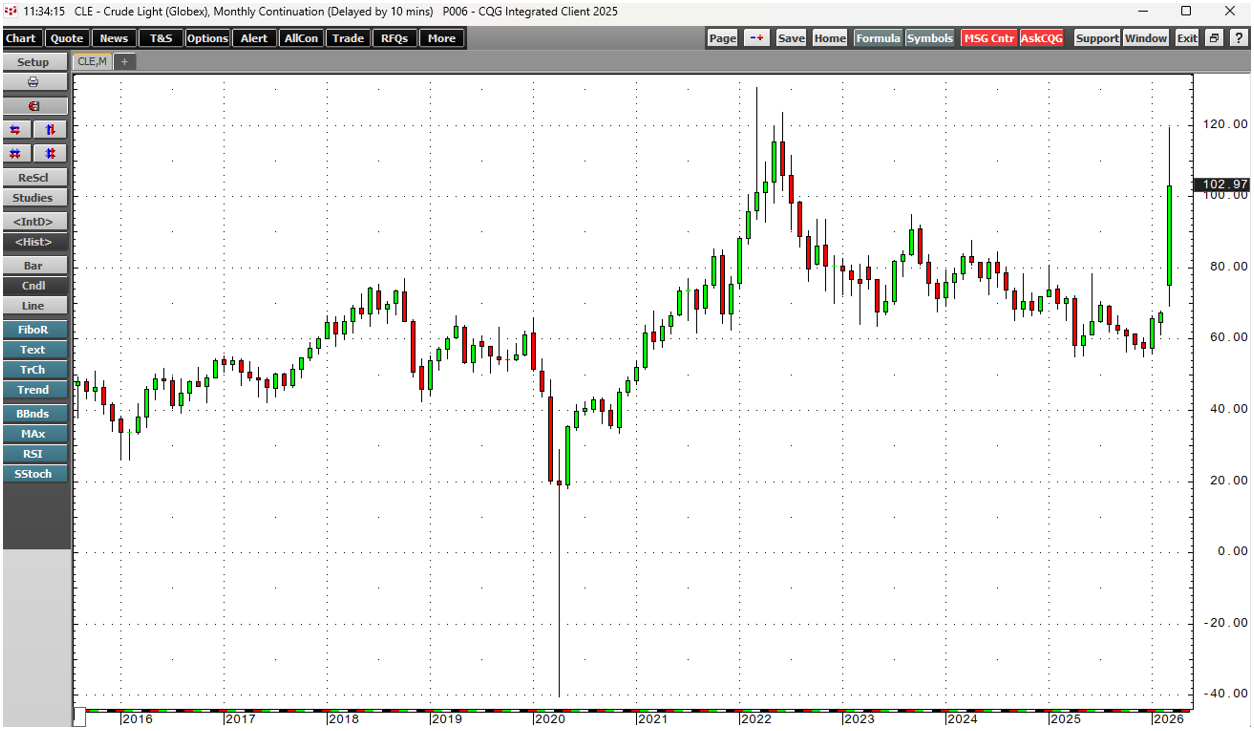
The monthly chart shows that above the recent $119.48 high; the upside targets are the 2022 high of $130.50 and the 2008 record high of $147.27 per barrel. The first technical support level is around $80 per barrel, with critical support around $55 per barrel.
Expect lots of volatility in crude oil prices in the current environment, and you will not be disappointed. Higher oil prices increase inflationary pressures, impacting markets across all asset classes.
The optimistic case
The critical factors over the coming weeks are the flow of crude oil through the Strait of Hormuz and the unfettered passage through the Red Sea. The optimistic case could cause crude oil prices to plunge, perhaps below $50 per barrel, for the following reasons:
- U.S. intervention in Venezuela could increase production from the country with the world's leading petroleum reserves.
- The Trump administration's U.S. "drill-baby-drill" and "frack-baby-frack" energy policy increased U.S. crude oil output.
- An end to the war in Iran that clears critical chokepoints and removes the potential for hostilities would likely cause crude oil prices to plunge.
Lower crude oil prices would reduce inflationary pressures, leading to lower U.S. interest rates and a stock market rally to new record highs.
The pessimistic case
A prolonged war with Iran and hostilities with Iranian proxies that impact logistical Middle East routes could cause crude oil prices to move to new all-time highs over the coming weeks for the following reasons:
- A prolonged conflict that closes the Strait of Hormuz and Red Sea transit routes to seaborne crude oil will create supply shortages.
- Continued attacks on Middle East countries' production and refining facilities could have a devastating impact on world crude oil and oil product supplies.
- Reducing the global strategic petroleum reserves would have a direct impact on the oil futures market.
- If the Iranian regime holds off U.S. attacks and any attempt to control Kharg Island could cement control of the Strait of Hormuz, turning it into a tollway for global oil supplies, since nearly 34% of global crude oil trade passed through the Strait in 2025.
- Houthi participation in the war threatens another logistical chokepoint on the Red Sea, the Bab el-Mandeb Strait.
The bottom line is that the coming weeks will determine whether crude oil is heading for a new record high or prices will plunge below the late 2025 and early 2026 lows. Trading crude oil is the optimal approach in the current environment, but expect price moves to be explosive, implosive, or both, depending on the news cycle. Risk-reward dynamics are critical when approaching any risk positions in the energy commodity that continues to power the world.